



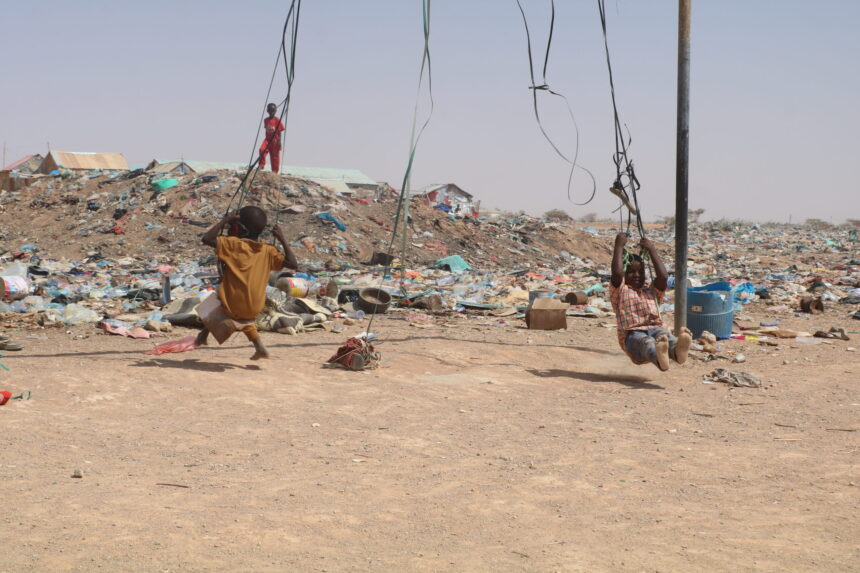
Mulki is a mother of five orphaned children who was displaced from southern Somalia. She and her children live in a makeshift shelter built from corrugated iron sheets and wooden planks in Shabelle IDP camp, located on the eastern outskirts of Garowe, the capital of Puntland State, Somalia.
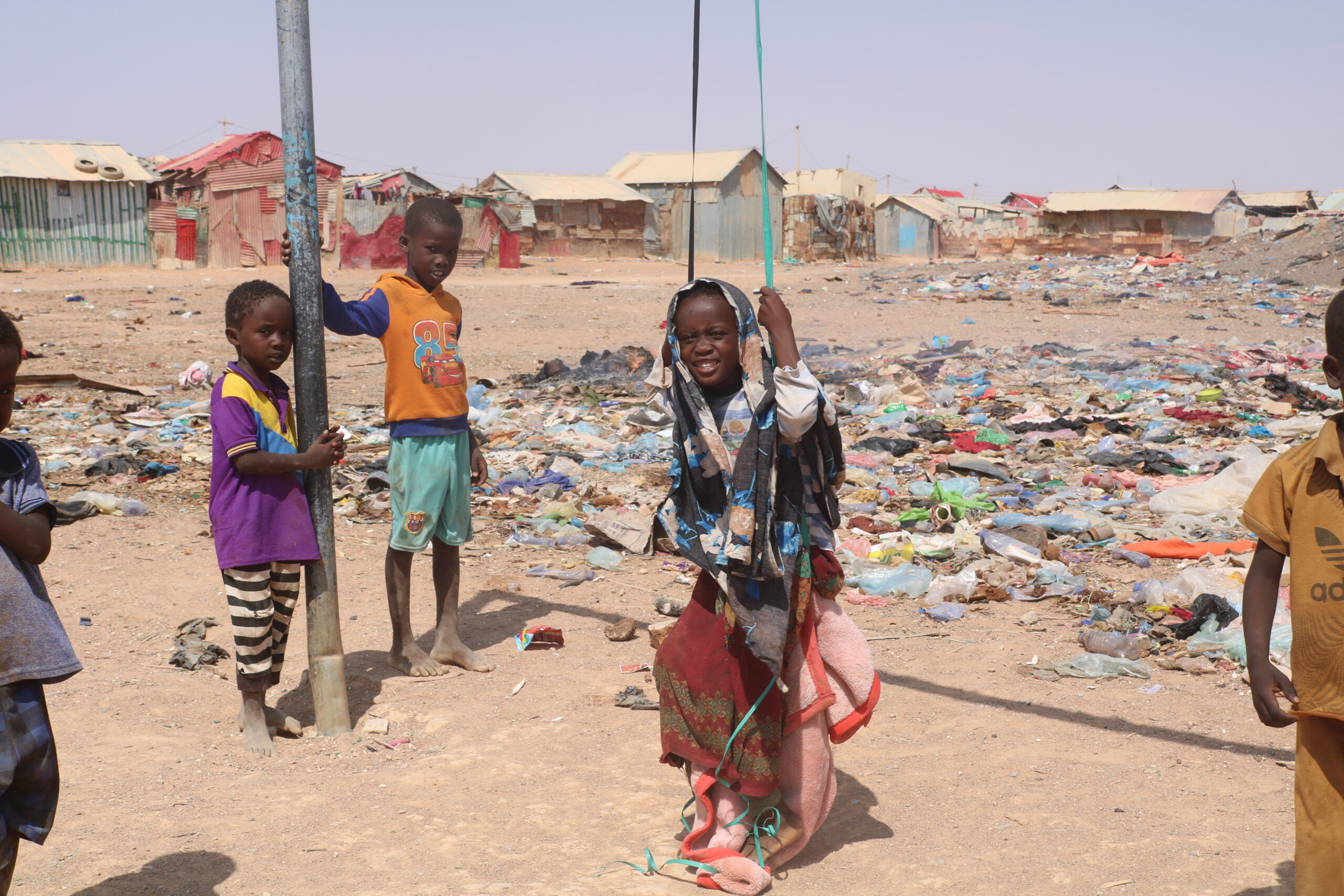
Their home sits less than 15 metres from large mounds of waste, where her children play every day without shoes, exposing them to constant danger. The oldest child is seven years old, while the youngest is just two. Like many displaced families, they lack access to basic services they are entitled to, including healthcare, education, and adequate food. Yet the most immediate and invisible threat they face is the toxic waste surrounding them.
Every morning at dawn, Mulki, 38, walks into the city in search of casual work, mainly washing clothes, hoping to earn enough to feed her children. She leaves them behind in the camp, which is home to an estimated 30,000 people, according to government agencies.
“I leave the house at first light to look for work in town, especially laundry jobs, just to cover basic needs like food,” Mulki said, sitting beside her children after returning from the city. “It’s not regular work. Some days I find something, other days I don’t. Most of the time, I return around midday.”
While she is away, her children spend their time playing on the heaps of waste nearby, often sustaining visible injuries.
“While I’m gone, they all play there, right next to the piles of rubbish,” she said. “They get hurt by sharp metal and broken glass because they don’t have shoes and they are still very young.”
She added that her eldest child, who frequently goes to the dumping site with other children, has suffered several leg injuries after stepping on sharp metal and glass.
The camp has no functioning health facility apart from a small MCH centre that depends on support from international aid agencies. As a result, children injured by waste rarely receive proper medical treatment.
“When a child gets injured, there is no health centre we can go to,” Mulki said. “I treat them at home by washing the wound with hot water and wrapping it with cloth. That’s all I can do.”
During the rainy season, sanitation conditions in the camp deteriorate further as water flows through the waste mounds. According to Mulki, outbreaks of diseases such as acute diarrhoea and respiratory infections become common.
The waste, much of it generated within the camp and some transported from the city, poses a serious health risk to thousands of displaced families living there. It includes a mixture of hazardous materials such as used batteries, expired medicines, glass, scrap metal, plastic waste, and other substances harmful to both people and the environment.
Clarifying hazardous waste and municipal waste
Most of the waste surrounding Shabelle camp consists of general municipal refuse generated by households, markets, and small businesses, reflecting Puntland’s broader solid waste management challenges. However, the presence of used batteries, medical waste, expired medicines, burnt electronic components, and chemical residues introduces a hazardous dimension that goes beyond ordinary sanitation failures.
Under the Basel and Bamako Conventions, not all waste falls under international hazardous waste obligations. These frameworks apply specifically to waste that is toxic, infectious, corrosive, flammable, or otherwise dangerous to human health and the environment. Environmental experts warn that when such hazardous materials are mixed into open dumping sites, burned in the open, or handled without protection, they raise risks that fall squarely within the scope of hazardous waste control and public health protection.
In Shabelle camp and other sites visited for this investigation, it is this hazardous fraction of the waste stream, rather than general household refuse alone, that poses the most serious long term threat to children, soil, and water sources.
The scale of the problem
Across Puntland, there are no properly designated or managed waste disposal sites. Waste is commonly dumped near urban areas, often on former grazing land that has now turned into massive rubbish dumps.
The waste includes hospital refuse, electronic waste such as batteries, and large volumes of plastic, which together have caused widespread environmental damage.
This situation is driven by two main factors. The first is the absence of a functioning waste management system, allowing individuals to dump waste wherever they choose. The second is weak oversight by government institutions responsible for environmental protection.
Health and environmental impacts
Across Africa, the health and environmental consequences of poor waste management and illegal dumping of hazardous waste have been widely documented by international organisations. The United Nations Environment Programme reports that most African countries still rely on open dumping, where household, medical, electronic, and hazardous waste are mixed together, leading to contamination of soil, groundwater, and marine ecosystems.
The World Health Organization has warned that open burning and uncontrolled dumping release toxic substances, including heavy metals and dangerous fumes, which can cause respiratory diseases, cancers, and the spread of infectious illnesses. High profile incidents, such as the 2006 toxic waste dumping case in Côte d’Ivoire documented by UNEP, illustrate how hazardous waste can result in widespread health crises and long term environmental damage.
The Bamako Convention clearly defines the dumping of hazardous waste as an environmental crime and a violation of human rights, obligating African states to prevent activities that endanger human life and the environment.
Despite extensive documentation elsewhere on the continent, Somalia continues to face a significant gap in data and research. There are no regular independent studies measuring soil, water, or air contamination from uncontrolled dumping. Nor is there official health data directly linking rising disease patterns to exposure to hazardous waste.
Government and environmental institutions do not conduct systematic monitoring, and there are no public records identifying dumping sites, types of waste, or responsible actors. Environmental experts say this lack of data increases vulnerability, weakens accountability, and undermines Somalia’s ability to meet its obligations under regional and international environmental agreements.
Medical observations
Dr Abdirahman Ali, a physician working in Puntland, said waste poses a serious health threat, particularly to displaced communities living near dumping sites.
“Waste causes severe health problems for displaced people, who are already vulnerable and lack access to healthcare,” he said. “The most common cases we see are skin diseases among children, as well as widespread gastrointestinal illnesses like diarrhoea, especially during the rainy season.”
A national study conducted in Somalia between 2022 and 2023 found that more than 60 percent of health facilities lack proper systems for segregating and managing infectious and sharp medical waste. Many facilities rely on open burning or shallow burial pits to dispose of hazardous materials.
This practice increases the risk of improper dumping, potentially spreading diseases such as HIV, hepatitis B and C, and other infections. The study highlighted the urgent need for clear policies, staff training, and investment in medical waste management systems to reduce health risks in healthcare settings across Somalia.
How dumping sites emerge
In Garowe, waste reaches dumping sites through several channels. Individuals often transport waste themselves and dump it on the outskirts of the city. In addition, private waste collection companies dispose of waste in locations not designated for waste management, including materials that pose serious risks to human health and the environment, according to local elders.
“Business owners and waste companies take rubbish and dump it wherever they want, especially on the outskirts of the city, in IDP settlements, or in grazing areas,” said Abdidahir Omar, a local traditional elder. “Private waste collectors play a major role because they dump mixed waste, including medical waste from health facilities, without any separation.”
These companies and individuals operate with little to no accountability. There is no regular monitoring of how waste is managed.
“No one supervises this work,” the elder added. “The responsibility lies with the local government and the Ministry of Environment, but neither has strict regulations or effective oversight to control waste dumping.”
Localised failures, not a uniform national picture
The dumping sites documented in this report do not represent waste management practices everywhere in Somalia. Conditions and institutional capacity vary widely across regions, municipalities, and institutions. In some urban centres and health facilities, waste handling systems, partner supported clean up initiatives, and emerging municipal by laws are beginning to improve collection and disposal practices.
However, in rapidly expanding towns and displacement settlements such as those on the outskirts of Garowe, waste governance remains weak and uneven. These sites reflect localised implementation failures where urban growth, displacement, and limited oversight intersect, rather than a single national system operating uniformly across the country.
Environmental researchers note that it is precisely these unregulated urban fringes and IDP settlements that are most vulnerable to hazardous dumping, because they fall between municipal responsibility, humanitarian response systems, and environmental enforcement structures.
Government responsibility and gaps
While preparing this report, attempts were made to contact relevant government institutions, including the Ministry of Environment and the Garowe municipal administration, to seek clarification on waste management practices. Both declined to comment.
Garowe has two licensed private waste collection companies contracted by the municipality. These companies use large trucks to collect waste but do not separate household waste from medical or industrial waste, including discarded medicines and hazardous materials, according to direct observations of their operations.
Although Somalia is in the process of completing ratification of the Bamako Convention, the country still lacks a functional system to regulate hazardous waste management, protect public health and the environment, ensure effective oversight, or raise public awareness about the risks communities face.
One of the core objectives of the Bamako Convention is to ensure that waste disposal is conducted in an environmentally sound manner. However, conditions observed in Puntland suggest that hazardous waste is routinely mixed with municipal refuse and dumped in open areas near residential settlements without treatment, containment, or monitoring.
Bamako commitments and the reality on the ground
Somalia has formally acknowledged its long history of environmental injustice and exposure to hazardous waste, framing toxic waste management as an issue of national security, public health, and sovereignty. The government says it is strengthening environmental governance through its National Transformation Plan 2025 to 2029, a new Environmental Management Bill, and municipal waste by laws, and has announced it is in the final stages of ratifying the Bamako Convention to protect the country from hazardous waste flows.
These commitments signal a shift from policy toward stronger environmental protection frameworks. However, conditions observed in parts of Puntland highlight how far implementation capacity still lags behind stated goals.
In Garowe’s outskirts and surrounding displacement settlements, open dumping continues, hazardous waste systems are absent, environmental testing is rare, and enforcement remains weak. There is little evidence of structured hazardous waste segregation, treatment, or disposal consistent with the obligations Somalia is preparing to assume under the Bamako Convention.
As communities continue to live beside open dumping sites containing hazardous components, environmental governance remains largely aspirational, exposing how institutional weakness, limited resources, and uneven implementation continue to undermine the protections promised in law and policy.